Climate Policy and Green Economy Journal

Volume 1 Issue 1 (2025)

Articles Article ID: 1850

Trapped in Tradition or Trailblazing Change? Unveiling the Dual Nature of Path Dependence in Manufacturing Pollution Control

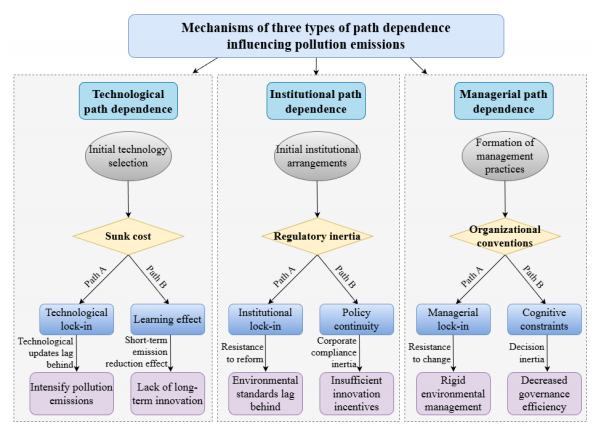
This study employs panel data from 1884 listed manufacturing companies in China (2009–2021) to investigate the environmental effects of path dependence on atmospheric pollution emissions. Using dictionary-based textual analysis of annual reports, we measure three dimensions of path dependence—technological, institutional, and managerial—and examine their non-linear relationships with sulfur dioxide emissions through fixed-effects models. Our findings reveal consistent U-shaped patterns across all dependence types: moderate levels initially reduce emissions (the “honey phase”) while excessive reliance leads to increased pollution (the “arsenic phase”). The analysis demonstrates that technological path dependence operates through sunk costs and learning effects, institutional dependence reflects regulatory inertia, and managerial dependence stems from organizational routines. Robustness tests using alternative pollution measures and instrumental variable approaches confirm these relationships. The study identifies significant heterogeneity in these effects. Non-state-owned enterprises exhibit stronger path dependence impacts due to greater flexibility, while high-maturity firms show amplified U-curves reflecting their accumulated experience. Conversely, capital-intensive enterprises display attenuated effects, suggesting diminishing returns to scale in pollution control. These findings highlight the dual nature of path dependence as both a stability mechanism and potential barrier to innovation. The policy implication is that manufacturing pollution control strategies should account for both dependence levels and firm-specific characteristics, maintaining path dependence within optimal ranges to harness stabilization benefits without impeding technological transitions. This research contributes to environmental governance literature by extending path dependence theory to pollution control and offering a multidimensional analytical framework for sustainable manufacturing transformation.

Articles Article ID: 2251

Macroeconomic Determinants of Environmental Degradation in India: An Empirical Investigation

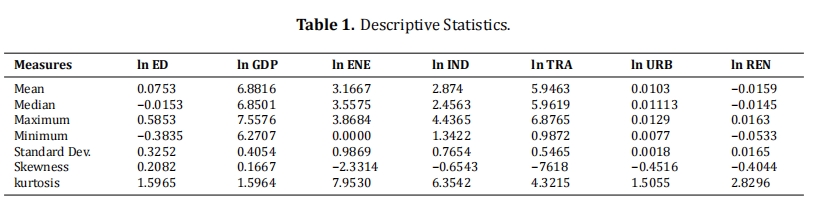
Understanding the macroeconomic drivers of environmental degradation is essential for formulating effective sustainability strategies in emerging economies. This study examines the long-run and short-run relationships between environmental degradation and key macroeconomic factors in India, including economic growth, energy consumption, industrialization, trade openness, urbanization, and renewable energy use over the period 1990–2023. Using annual time-series data and applying the Autoregressive Distributed Lag (ARDL) bounds testing approach with an error-correction framework, the analysis confirms the existence of a stable long-run equilibrium relationship among the variables. The results indicate that economic growth and conventional energy consumption exacerbate environmental degradation in the long run, reflecting persistent scale effects and fossil fuel dependence, while trade openness and renewable energy adoption mitigate environmental pressures through technological diffusion and cleaner energy transitions. Urbanization emerges as a significant structural driver of environmental stress, particularly in the long run, highlighting the role of unplanned urban expansion and rising energy demand. The short-run dynamics reveal meaningful adjustment processes, suggesting that environmental outcomes respond gradually to macroeconomic and policy shocks. Overall, the findings imply that achieving environmental sustainability in India requires accelerating the energy transition, promoting low-carbon industrial development, strengthening sustainable urban governance, and systematically integrating environmental objectives into national growth and trade policies to decouple economic development from environmental degradation.

Articles Article ID: 2406

Research on Collaborative Governance Strategies for Air Pollution Based on Differential Game Theory

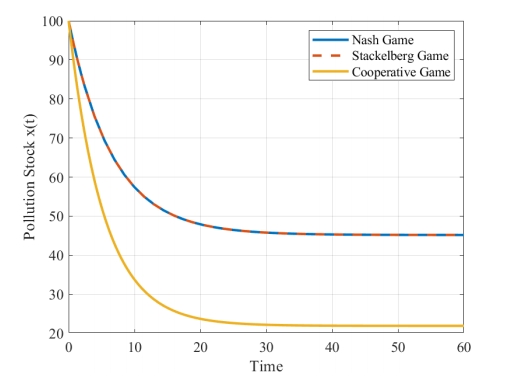
In recent years, air pollution has become an increasingly important issue along with economic and industrial development. To study the interaction between government and enterprises in pollution control, we have developed a differential game model and analyzed their dynamic decision-making process under different governance situations. Three scenarios are considered, including a Nash non-cooperative game, a Stackelberg game led by the government, and a cooperative game with subsidies. The results show that under both the Nash and Stackelberg games, the strategies of government regulation and enterprise emission reduction are completely identical, and the pollution stock remains at a relatively high level. In these two situations, enterprises tend to stay in a passive emission reduction state, so the improvement in pollution governance is limited. However, under the cooperative game, the government encourages enterprises by providing subsidies for emission reduction. As a result, enterprises are more willing to increase their abatement efforts, while the government can reduce part of its regulatory pressure at the same time. Compared with the other two scenarios, the pollution stock decreases more significantly in the cooperative case. These findings indicate that subsidy policies can improve cooperation between government and enterprises and help achieve better environmental governance. And this study may provide some references for the design of air pollution control policies.

Review Article ID: 2424

Innovation for Climate Change Adaptation: A Meta-Analysis

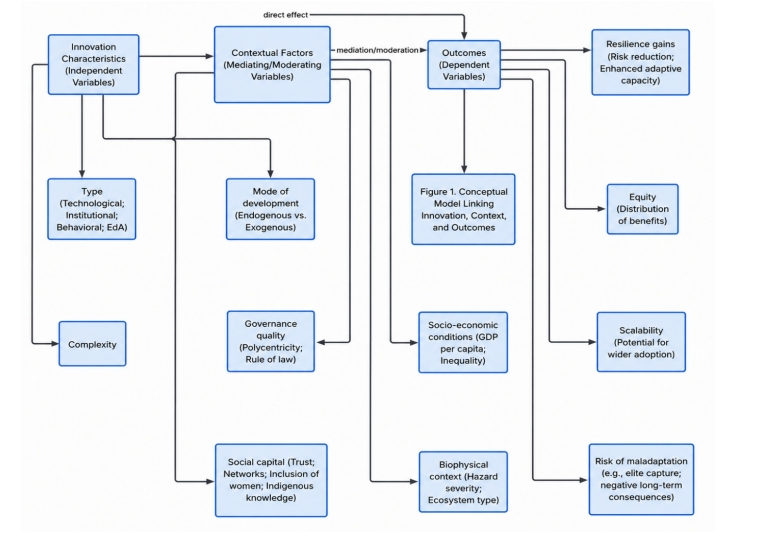
Addressing climate change requires embedding innovative approaches to overcome the growing “adaptation deficit.” However, evidence on the effectiveness, scalability, and equity of different types of innovation remains fragmented. This study presents a systematic review and meta-analysis of 418 peer-reviewed studies (2010–2023) conducted in accordance with Preferred Reporting Items for Systematic Reviews and Meta-Analyses (PRISMA) 2020 protocols. We synthesize global evidence to: (1) assess the comparative effectiveness of technological, institutional, behavioral, and ecosystem-based adaptation (EbA) innovations; (2) identify contextual moderators of success; and (3) evaluate equity outcomes using the PROGRESS-Plus framework. Random-effects meta-analysis reveals that hybrid approaches combining institutional and behavioral components significantly outperform technological solutions, yielding higher resilience outcomes (Hedges’ g = 1.24, 95% CI [1.07–1.41]), with a 39% improvement (p < 0.001). EbA innovations are the most cost-effective, at $127 per resilience unit compared to $412 for technological interventions, yet remain critically underfunded. Innovation effectiveness is highly context-dependent. Institutional innovations are less likely to succeed in contexts with GDP per capita below $2,500 (OR = 0.24). Equity outcomes improve significantly with ≥40% women’s participation (β = 0.49, p = 0.008) and Indigenous knowledge integration (β = 0.52, p = 0.003). In contrast, 73% of technological implementations exhibit elite capture, and 22% risk maladaptation due to neglected socio-ecological feedback. Publication bias correction reduced the pooled effect size by 18%, revealing a tendency toward overstating success in the literature. These findings underscore the imperative to reorient adaptation finance and governance toward polycentric, justice-driven frameworks. We propose three pathways: establishing innovation broker authorities, adopting equity-weighted financing, and deploying equity-focused adaptation dashboards.