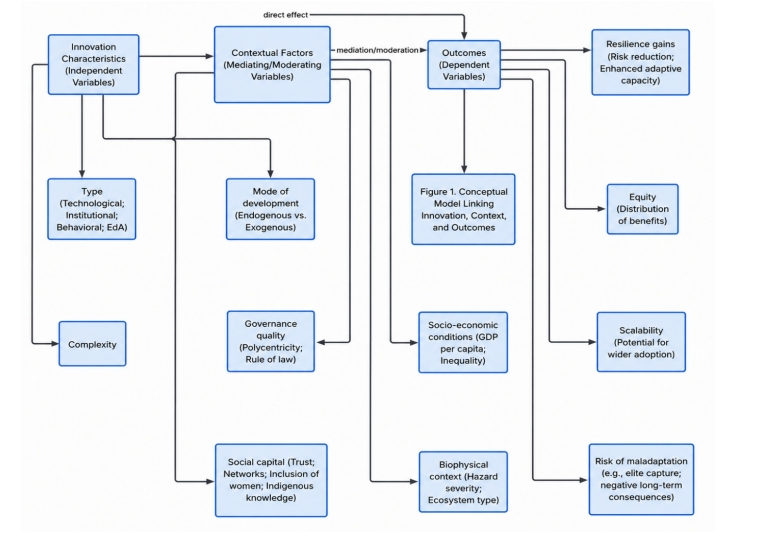
Addressing climate change requires embedding innovative approaches to overcome the growing “adaptation deficit.” However, evidence on the effectiveness, scalability, and equity of different types of innovation remains fragmented. This study presents a systematic review and meta-analysis of 418 peer-reviewed studies (2010–2023) conducted in accordance with Preferred Reporting Items for Systematic Reviews and Meta-Analyses (PRISMA) 2020 protocols. We synthesize global evidence to: (1) assess the comparative effectiveness of technological, institutional, behavioral, and ecosystem-based adaptation (EbA) innovations; (2) identify contextual moderators of success; and (3) evaluate equity outcomes using the PROGRESS-Plus framework. Random-effects meta-analysis reveals that hybrid approaches combining institutional and behavioral components significantly outperform technological solutions, yielding higher resilience outcomes (Hedges’ g = 1.24, 95% CI [1.07–1.41]), with a 39% improvement (p < 0.001). EbA innovations are the most cost-effective, at $127 per resilience unit compared to $412 for technological interventions, yet remain critically underfunded. Innovation effectiveness is highly context-dependent. Institutional innovations are less likely to succeed in contexts with GDP per capita below $2,500 (OR = 0.24). Equity outcomes improve significantly with ≥40% women’s participation (β = 0.49, p = 0.008) and Indigenous knowledge integration (β = 0.52, p = 0.003). In contrast, 73% of technological implementations exhibit elite capture, and 22% risk maladaptation due to neglected socio-ecological feedback. Publication bias correction reduced the pooled effect size by 18%, revealing a tendency toward overstating success in the literature. These findings underscore the imperative to reorient adaptation finance and governance toward polycentric, justice-driven frameworks. We propose three pathways: establishing innovation broker authorities, adopting equity-weighted financing, and deploying equity-focused adaptation dashboards.

 249 (Views)
  152 (Downloads)